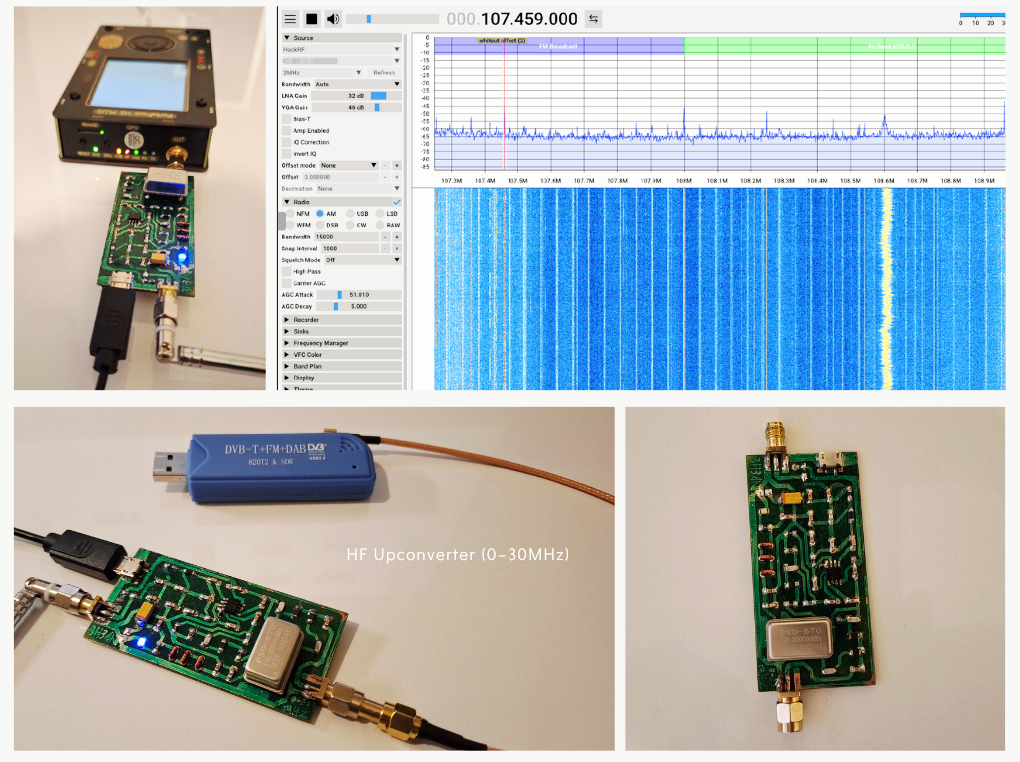
Most low-cost SDR receivers struggle with direct reception of HF signals below 30 MHz. A common solution is to use an upconverter that shifts HF signals into a frequency range that can be received more effectively by SDR hardware.
This project is a compact redesign of an HF upconverter intended for use with SDR platforms such as RTL-SDR and HackRF One. The hardware was redesigned as a compact SMD implementation and adapted for USB-powered operation.
How It Works
The design is based on the NE602A mixer/oscillator IC. A crystal-controlled local oscillator operating near 100 MHz is mixed with incoming HF signals, producing translated frequency components approximately 100 MHz above the original signal.
Examples:
- 7 MHz → ~107 MHz
- 14 MHz → ~114 MHz
- 21 MHz → ~121 MHz
This allows HF signals to be received and analyzed using standard SDR hardware and software.
Design Changes
- USB-powered operation (5V input)
- Full SMD implementation
- Compact PCB redesign
- Optimized component placement for manual assembly
PCB Notes
The prototype was assembled in a home-lab environment. To simplify soldering and debugging, the ground polygon was intentionally reduced.
For future revisions, a continuous ground plane can be restored to improve shielding effectiveness, noise immunity, and overall RF performance.
Power Supply Considerations
During testing, battery-powered sources and high-quality power banks produced cleaner results than typical laptop USB ports.
USB power from laptops may introduce switching noise and ground contamination that can affect sensitive RF stages and measurement accuracy.
Validation
The converter was tested using both HackRF One and RTL-SDR receivers.
Frequency translation was verified through SDR spectrum analysis and practical signal reception tests.
Project Repository
Complete design files, schematics, PCB renders, Gerber files, and validation images are available on GitHub:

No comments:
Post a Comment